
Mountain Rwenzori National Park
The Kingdom of Clouds and Ice
Have you ever wondered where the legendary “Mountains of the Moon” truly stand? For centuries, ancient explorers, geographers, and adventurers spoke about a mysterious mountain range hidden somewhere in the heart of Africa towering so high that its peaks were forever covered in snow, even though it sat near the equator. Today, we know exactly where these mythical mountains are found. They rise in overwhelming beauty along Uganda’s western border, forming the natural boundary between Uganda and the Democratic Republic of Congo. These are the Rwenzori Mountains, protected within the magnificent Rwenzori Mountains National Park.
Covering about 996 square kilometers, the park stretches across Kasese, Bundibugyo, and Kabarole districts, creating one of Uganda’s most dramatic landscapes. This rugged mountain chain extends roughly 120 kilometers, forming a breathtaking corridor of peaks, glaciers, rivers, valleys, cliffs, and mist-covered forests. It is a place where nature still feels ancient, where the world looks untouched by time, and where adventure hides around every corner.
The Rwenzori gained international fascination when Ptolemy, a famous Greek geographer, described them around AD 150 as the mystical snowcapped mountains feeding the Nile River. Though his writings seemed unbelievable at the time, they sparked centuries of curiosity. Europeans only reached the region much later, in the late 19th and early 20th centuries, when explorers like Henry Stanley, Luigi da Savoia, Thomas Parke, and Arthur Jephson set foot in the mountains. Their descriptions matched Ptolemy’s ancient account almost perfectly showing that the legend was, in fact, real.
Mountain Range like No Other
What sets the Rwenzori Mountains apart from other African giants like Kilimanjaro or Mount Kenya is that the Rwenzori are not volcanic. Instead, they were formed through tectonic uplift, with the mountains rising sharply from the Albertine Rift Valley floor. This gives them dramatic elevation changes, deep gorges, and steep slopes unlike anything else in East Africa.
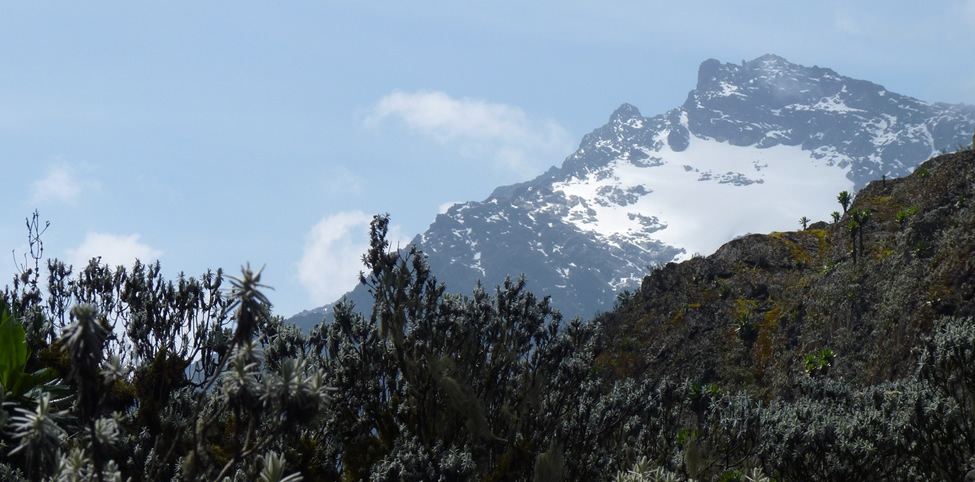
At the heart of the range is Mount Stanley, crowned by Margherita Peak standing tall at 5,109 meters, making it the third-highest peak in Africa. Alongside Margherita are peaks such as Alexandra (5,083m), Mount Speke (4,890m), Mount Baker (4,844m), and the icy summits of Mount Emin, Mount Gessi, and Mount Luigi da Savoia. These mountains create landscapes that feel almost otherworldly, especially where snow and glaciers glow under the equatorial sun.
For many climbers, standing on Margherita Peak is a dream come true. Yet even for travelers who do not attempt the summit, the lower slopes hold breathtaking beauty and endless adventure.