Queen Elizabeth National Park
If you have ever been to Uganda and know nothing about Queen Elizabeth National Park, then you betray me. Before I give you a hint, do you know why the park was named Queen Elizabeth? Obviously I have to tell you even the right date when it was gazatted and named. Initially it was called Kazinga National Park back in 1952 but later in 1954 it was named Queen Elizabeth National Park. Don't forget during Idi Amini's rule in 1970s, he tried renaming the park as Rwenzori National park and that’s what some maps had by then. It was named Queen Elizabeth National Park in 1954 to honor the visit of Queen Elizabeth II to Uganda.
At that time, Uganda was still a British protectorate, and it was common to commemorate royal visits by naming important landmarks after members of the British royal family. The renaming recognized both the Queen’s visit and the park’s significance as a major conservation area.
In the western region of Uganda lies Queen Elizabeth National Park, the country’s most popular and most visited Savanna Park. It stretches over an area of about 1,978 square kilometers, showcasing one of Africa’s most beautiful and diverse landscapes. The park is bordered by the Ishasha River and Lake Edward along the Congo border to the west, the Rwenzori Mountains and Kasese town to the north, Lake George, Kyambura Gorge, and Kalinzu Forest Reserve to the east, and the Kigezi Wildlife Reserve to the south.
Visitors to Queen Elizabeth National Park are welcomed with affordable entry fees. Non-residents are charged US$40 per day, while East African residents pay US$30 upon presenting proof of residency. Those simply driving along public roads that cut through the park, such as the Mbarara–Kasese highway, the Katwe dirt road, or the route between Katunguru and Ishasha, do not pay an entrance fee. These roads gives travelers scenic glimpses of the park’s beauty even before entering its wild heart.
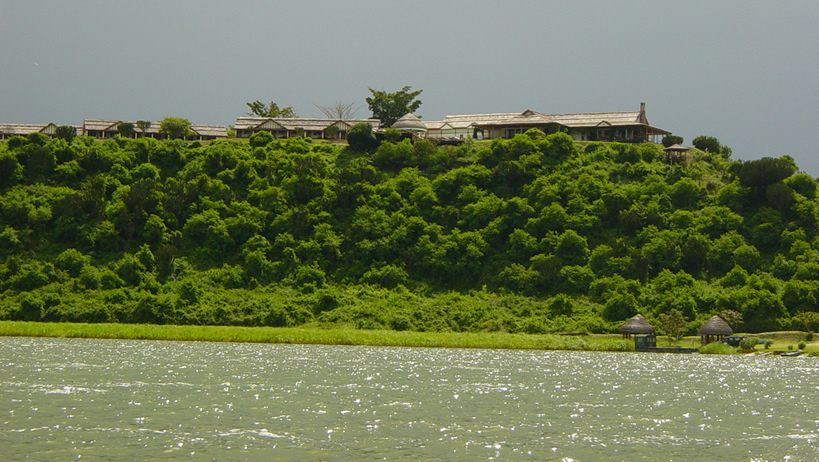
Queen Elizabeth National Park is mostly made up of open savanna grasslands dotted with acacia and euphorbia trees. Beyond the plains, it shelters large swamps surrounding Lake George, the dense and ancient Maramagambo Forest in the southeast, and the lush, forested Kyambura Gorge, which borders the Kyambura Game Reserve. The park’s terrain is truly diverse from endless grasslands and crater lakes to thick forests and shimmering waterways. More than ten crater lakes lie within the park’s boundaries, including a group of beautiful lakes easily accessible near the main road to Mweya Safari Lodge. The park also includes the Ugandan section of Lake Edward, the northern and western shores of Lake George, and the famous Kazinga Channel, which links the two lakes and supports one of the highest concentrations of hippos in the world.
The amazing beauty of Queen Elizabeth National Park is matched by its outstanding variety of wildlife. It boasts 95 species of mammals, the highest recorded in any Ugandan park. Among these are elephants, buffaloes, hippos, lions, and leopards, along with numerous species of antelope and primates. The park is home to ten primate species, including chimpanzees, vervet monkeys, red-tailed monkeys, L’Hoest’s monkeys, blue monkeys, black-and-white colobus, and olive baboons. Visitors can often spot these playful primates jumping between trees or foraging along the forest edges.
Predators also thrive here. About twenty species are found within the park, including lions, leopards, spotted hyenas, and side-striped jackals. The Ishasha sector, in the southern part of the park, is famous for its rare tree-climbing lions, a unique behavior seen in only a few places in the world. These lions can often be seen resting on the branches of large fig trees, enjoying the cool breeze and watching over the herds of Uganda kob grazing below. The sight of a golden lion stretched lazily on a tree limb against the blue sky is one of the park’s most iconic images.
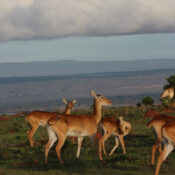
Antelopes are widespread across the plains. The most common include Uganda kob, which serve as the main prey for lions, as well as topi, bushbuck, and Defassa waterbuck. In the papyrus swamps near Lake George, the rare sitatunga antelope, a shy, semi-aquatic species, can sometimes be seen. Within the thick Maramagambo Forest, smaller duiker species browse quietly under the canopy, rarely seen but always present.
Buffaloes are another key feature of Queen Elizabeth National Park. Many of them have a reddish color because they interbreed with the forest buffaloes from the nearby Congo forests. The park’s elephants also have a unique appearance slightly smaller and hairier than the typical savanna elephants, showing close relations to the forest elephants of the Democratic Republic of Congo. This blend of savanna and forest species makes Queen Elizabeth National Park one of Africa’s most ecologically fascinating areas.
| Distance from Kampala | Spanish |
|---|---|
| Entrance Fees | Euro (EUR) |
| Park Size | 195,360 sq mi |
| Altitude | Kingdom of Spain |
| Park Location | Visa is not required for EU citizens. Everyone else needs a Visa. |