
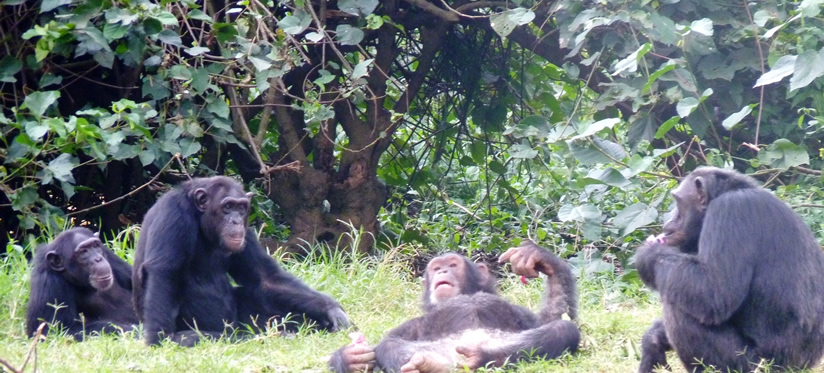
426 Chimpanzees in Bwindi after Census by Rangers
There is fresh excitement in Uganda’s conservation sector following the official confirmation that 426 chimpanzees are living inside Bwindi Impenetrable National Park.
The results were unveiled by the Uganda Wildlife Authority (UWA) in partnership with the Jane Goodall Institute, marking the first comprehensive chimpanzee census conducted in Bwindi. For a park that has long been celebrated globally for its mountain gorillas, this announcement opens a powerful new chapter in Uganda’s conservation story.
For decades, Bwindi has drawn visitors from across the world because of its endangered gorillas. Now, the forest is gaining renewed recognition as an important sanctuary for another extraordinary primate the intelligent and social chimpanzee.
Bwindi, a Forest That Breathes Life
Bwindi Impenetrable National Park is one of Africa’s oldest and most biologically rich rainforests. Recognized as a World Heritage Site by UNESCO, the park is a treasure not only for Uganda but for the entire world.
The forest stretches across steep hills, mist-covered valleys, and thick vegetation that can sometimes feel almost untouched by time. Towering trees form a green canopy overhead, while vines, shrubs, and ferns create dense undergrowth below. It is this layered ecosystem that makes Bwindi so special.
Chimpanzees thrive in such an environment because it provides exactly what they need: tall fruiting trees for food, strong branches for nesting, reliable streams for water, and relative safety from human disturbance. A forest like Bwindi is not just habitat it is a complete living system that supports survival, reproduction, and long-term stability.
The census, conducted in two sweeps between May and September 2025, confirmed that chimpanzees are well distributed in key sections of the park. The figure of 426 individuals reflects a stable and viable population, a promising sign for conservationists who have worked tirelessly to protect Uganda’s forests.
How the Census Was Carefully Conducted
Counting chimpanzees in a dense rain-forest is not a simple task. Unlike animals that live in open Savannahs, chimpanzees move through thick vegetation, often high in the trees. Direct sightings alone cannot provide accurate results.
To ensure reliable data, researchers from the Jane Goodall Institute worked closely with experienced rangers from UWA. Together, they applied scientific methods that have been refined over years of primate research.
One of the main techniques used was nest counting. Every evening, chimpanzees build new nests in trees where they sleep. These nests are temporary and usually abandoned the next morning. By identifying and counting nests, and studying how long they last before decomposing, researchers can estimate the number of chimpanzees living in a given area.
Teams also recorded vocalizations the loud pant-hoots and calls that echo through the forest as well as feeding signs, trails, and habitat use patterns. Trail mapping and habitat analysis allowed scientists to understand not just how many chimpanzees exist, but where they prefer to stay and how they move within the park.
This careful and structured process ensures that conservation planning is based on real evidence, not assumptions. It strengthens park management decisions and guides future monitoring efforts.
Understanding the Nature of Chimpanzees
Chimpanzees are among the most fascinating animals in the world. They share nearly 98 percent of their DNA with humans, making them our closest living relatives.
But beyond genetics, what truly makes chimpanzees remarkable is their intelligence and emotional depth.
They recognize each other as individuals. They build friendships. They comfort distressed group members. They use tools, such as sticks to extract termites from mounds or stones to crack nuts. They teach their young survival skills through observation and practice.
Young chimpanzees remain close to their mothers for several years. During this time, they learn what to eat, how to climb safely, how to build nests, and how to behave socially. This long childhood is one of the reasons chimpanzee societies are complex and deeply connected.
Their social structure is known as a “fission-fusion” system. This means that large communities may split into smaller groups during the day to search for food, then reunite later. This flexibility helps them adapt to changing food availability within the forest.
Watching chimpanzees interact can feel surprisingly human. You may see playful chasing among juveniles, careful grooming between adults, or displays of strength from dominant males. Each behavior reveals a social world full of communication and relationships.
Chimpanzees across Uganda
Uganda is one of the best places in Africa to see chimpanzees in the wild. Besides Bwindi, they are found in: Kibale National Park, Budongo Forest, and Kyambura Gorge.
Kibale National Park is particularly famous for chimpanzee tracking and is often called the primate capital of East Africa. However, the confirmation of 426 chimpanzees in Bwindi significantly strengthens Uganda’s overall primate tourism portfolio.
It shows that conservation success is not limited to one forest. Instead, Uganda’s protected areas together form a strong network of habitats that support endangered species.
The Thrill of Chimpanzee Trekking
Have you got your trekking permit? Chimpanzee trekking in Uganda offers visitors a truly immersive experience. Unlike observing wildlife from a vehicle, chimpanzee tracking requires entering the forest on foot, guided by trained rangers.
The day begins with a briefing at the park headquarters. Rangers explain safety guidelines and share insights about chimpanzee behavior. Small groups then set off into the forest, following fresh signs such as broken branches, footprints, or distant calls.
Tracking can take one to several hours depending on the chimpanzees’ movements. The journey itself is part of the adventure. Along the way, visitors learn about medicinal plants, bird species, and the interconnected life of the rain forest.
When the chimpanzees are finally located, the reward is unforgettable. Visitors are allowed one hour in their presence. During that time, you may see them feeding on ripe fruits, resting quietly in treetops, grooming each other, or moving swiftly through branches.
Unlike gorillas, chimpanzees are highly active. They can be playful and energetic, sometimes swinging through trees with incredible speed. Their loud calls can echo dramatically through the forest canopy, adding to the thrill of the moment.
Tourism revenue from such experiences plays a crucial role in supporting conservation programs and community development projects.
Conservation Success Comes with Responsibility
Chimpanzees are classified as endangered across Africa. Their populations have declined due to deforestation, illegal hunting, disease outbreaks, and expanding human settlements.
Uganda has made significant progress in protecting its primates through strict law enforcement, ranger patrols, research partnerships, and public awareness campaigns. The confirmation of 426 chimpanzees in Bwindi shows that protected forests, when managed well, can sustain healthy populations.
However, conservation is not a one-time achievement. It requires ongoing monitoring, continuous funding, and strong political support.
The Role of Communities
Communities living around Bwindi are essential partners in conservation. Many depend on agriculture for their livelihoods. When wildlife enters farms and damages crops, tensions can arise.
To reduce conflict, programs focus on creating buffer zones, supporting alternative income activities, sharing tourism revenue, and improving education about wildlife conservation.
When communities see real benefits from tourism and conservation, they become active protectors of the forest. This partnership approach strengthens long-term sustainability.
Milestone with Global Significance
The chimpanzee census does more than provide a number. It strengthens Uganda’s reputation as a serious conservation leader. It attracts researchers and conservation investors. It enhances tourism marketing efforts. And it reinforces the value of Bwindi as a diverse ecosystem, not only a gorilla destination.
Most importantly, it sends a message of hope.
In a world where wildlife populations are often declining, the confirmation of 426 chimpanzees in Bwindi proves that conservation efforts can succeed. It shows that when science, leadership, and community collaboration come together, nature responds positively.
Deep within the green hills of Bwindi, the calls of chimpanzees continue to echo through ancient trees. They are a reminder that Uganda’s forests are alive and that with continued commitment, they will remain so for generations to come.